Showing posts with label zeuzzz banning. Show all posts

Saturday, 13 April 2013

The 'on consciousness' JREF thread; psychedelics are to the study of consciousness what the telescope is to the study of astronomy.

To explain my propensity for posting psychedelic material in the thread about consciousness, which resulted in several warnings for 'hijacking the thread', despite the whole point of psychedelics propensity to peturb consciousness being one of the most fruitful ways to study consciousness and will remain so in the future via the rapidly evolving discipline of psycho-pharmacology, I feel I should explain in more detail what I posted and why; since the psychedelics link to consciousness seemed lost on most members, which is seemingly why the dubious hijack cautions were issued. I actually rarely posted on the forum about psychoactives as other forums always seemed more suitable, and rarely, if ever, advocated their use, unless their medicinal value had been clinically proven. Until I am made aware of the length of the suspension and the reason for it my musings on that thread will be posted here, to try to summarize why I posted what I did. Some of this next paragraph is paraphrased from Mckenna.

With psychedelics as they relate to consciousness people seem confused by what is going on. Taking legal psychedelics has a certain measure of chiqueness about it. And you can get into the club by merely saying you took it, so the way to get into the club without paying your dues is to take some piss all amount and go around raving about that. So when we talked about the psychedelic experience its not clear we are all talking about the same thing, its sort of like talking about France to the people that moved their for a week an stayed in the airport and then talking to the people that moved their for twenty years and learned the language and studied the culture. I could relate to quarky and a few others on many matters as he has had many of the experiences I have had, whereas people like Pixy and most others had absolutely no points of reference for them to comprehend what I was saying.

There are thousands of altered states, we know them, orgasm, indigestion, two cappuccinos, sleep, where tequila takes you, where depression takes you, where anti depressants or adderal takes you. There are endless altered states in our culture, and I'm not interested in them particularly any more than anyone else is, I mean they are part of life. What I am interested in, as an experimentalist, as a connoisseur of nature, somebody who loves fossils, butterflies, rainbows, astronomy that kind of thing, is this family of compounds called the indole hallucinogens. And they cause hallucination. The reason I am so academically fascinated by hallucinations relationship to the science of consciousness is because to my mind when you are hallucinating you have an kind of indirect proof that you are not generating this material. It's not funny ideas. It's not racing thoughts. It's not insight into what your girlfriend really meant yesterday. That kind of thing we can do by just inspecting our own mind. 


Even the word hallucination is another term that people seem to be confused about. There are threshold hallucinations or level five experience hallucinations. However a true breakthrough hallucination is to be in the presence of that which previously could not be imagined. If it could previously not be imagined then there is no reason to believe that you generated it out of yourself. You know whats in your cupboard, you know whats in your chest of drawers, for Gods sake you ought to know whats in your own mind. So if something comes forward and you have to say 'thats not mine, that is not in my inventory, that's beyond even my imagination' then then you have a kind of proof that this is coming from somewhere else. And then you have the question: Where? Well we can set off into that, but opinions differ; no one has an empirical truth on it.

A reductionist or materialist, somebody who likely didn't like these substances or never tried them, will say that it's just neurological chaos, it's just you have interrupted the functioning of good brain chemicals and evil brain chemicals are giving a sense of chaos. Well that just doesn't cut the mustard. I mean that type of stuff might work on people who have never experienced it or on the troops, but not if you are talking to anyone who has ever been there. I know what a neurological chaos would look like, it would look like random bright lights, moving colors, physical seizures, etc. It would not be ruins, never before imagined landscapes, machines, paintings, works of art, building plans, weapons, bits of manufactured technological detritus; these things are too coherent. They're objects in some kind of superstructure of the mind.
I didn't get into this enterprise by being an airhead or a hippie. My attitude is if it's a real experience it can take the pressure. I am not saying psychedelic experiences are real in the sense of contacting aliens or entities; that leads to all sorts of epistemic complications, but the congruency of the experiences of totally disparate hallucinogens points to something totally inexplicable by typical molecular biology and neuroscience as it relates to conscious experience. You don't have to sidestep round the real thing, if people are telling you you should avert your gaze or or plug your ears, then you are probably in the presence of crap.

I tried buddhism and yoga in the East in Thailand, I looked into meditation, looked briefly into Christianity with the UDV, I was fast shuffled by beady eyed little mean in goatee's; I know the whole spiritual supermarket and rigmarole. Yet I find nothing there to interest me on the level of five grams of dried mushrooms in silent darkness. Thats where the pedal meets the metal. Thats where the rubber meets the road.

The inspiration for me to post in the consciousness thread about this simply comes from the fact that I can not believe that this could be culturally kept under raps despite the concrete science into the subject the way it has. In my opinion the psychedelic experience is as central to understanding your humanness as having sex, or having a child, or having responsibilities, or having hopes and dreams. And yet it is illegal. We are infantalized, we are told you can wander around within the sanctioned playpen of ordinary consciousness, and we have some intoxicants over here if you want to mess yourselves up, some scotch and some tobacco, red meat and sugar; but these boundary dissolving hallucinogens that give you a sense of unity with your fellow man and nature are somehow forbidden. This is an outrage, its a sign of cultural immaturity, and the fact that we tolerate it is a sign that we are living in a society as oppressed as any culture in the past.


I would never post this following information on the forum, thus why I never shared my subjective methods of using psychedelics in the past on the forum, but since it is now off forum I can. The way I recommend taking psychedelics is in perfect darkness, in silence, and with as little input from other people as possible, as recommended now in the clinical trials of psilocybin therapy, although they use a therapist in the same room with as little input as possible. I say alone if you are experienced, and if that gives you pause, and you must have a sitter, and lets call it a sitter, not guide, my god no-ones guiding you anywhere, they have no more idea where you are than we know where Santa Claus is at this point.

My idea of the perfect sitter is you have a little bell by your side, and the sitter is three rooms away, and if the sitter is needed you ring the bell, the sitter comes in and says 'its cool, lay down' and do that. When the experience is internalized in this manner the experience you get is totally different to doing it in a social environment, you close your eyes and you get an internal trip with closed eye visuals; which can be the most vivid and profoundly congruent  scenery, introspections into life, and as indicated with the new psilocybin studies one dose alone can provide what all subjects described as 'a deeply spiritual experience' that stays with people for a lifetime. 30% of people in the studies said that when they were administered psilocybin in a clinical setting the experience was the single most important and meaningful experience of their life.


Let me get this straight: My thing is not about my opinion, what I saw in Africa, or anything like that, get it straight, this is about an experience. Not my experience, your experience. It's about an experience which you have. Like getting laid or going to Africa. You must do the experience, else its just whistling past the graveyard. And we are not talking about something like being born again or meeting the flying saucers, no; if you take a sufficient dose of a safe active psychedelic compound with a high LD50 it will deliver itself to you on the money. If it doesn't work, take more; that is what LD50's are for! No one should be in a position to dismiss this just because it didn't work for them on one or two occasions.

This is an art, its something you coax into existence. I mean you have to learn to make love you have to learn to speak English, anything worth doing is an art, this is part of our birthright, perhaps the most important part of our birthright, these substances will deliver, it is the confoundment of psychology and science generally. And that's why it's so touchy for cultural institutions; but you are not a cultural institution, you are a free an independent human being and these things have your name written on them in big gold letters.


Something that has confounded modern science in general for the last 40 years was never going to be an easy thing to post about in the science section. I've tried my best but I had to choose my words very carefully. It's like trying to make your argument while having half your vocabulary removed by the use of rule one as it applies to psychoactives, thus why I tried to only talk about legal and natural ones. The reason I often brought up DMT was simply because it was in the body of every person that posted in that thread, so provided a window of opportunity to try to clarify the neurophysiological importance of these psychoactives on consciousness. 

If meditation is the best known and respected path for introspection, then the psychedelics cheat by putting you on the motorway, where you are more likely to crash. 

I don't think you could discover consciousness if you didn't perturb it, because as Marshall McClune said, "whoever discovered water, it certainly wasn't a fish". Well, we are fish swimming in consciousness; and yet we know it's there. Well, the reason we know it's there is because if you perturb it, then you see it; and you perturb it by perturbing the engine which generates it, which is the mind/brain system resting behind your eyebrows. If you swap out the ordinary chemicals that are running that system in an invisible fashion, then you see: it's like dropping ink into a bowl of clear water -- suddenly the convection currents operating in the clear water become visible, because you see the particles of ink tracing out the previously invisible dynamics of the standing water. The mind is precisely like that, and the psychedelic is like a dye-marker being dropped into this aqueous system.

When I personally say psychedelic I have something very specific in mind that a substance or a plant should do. It should not inhibit clarity, in other words not episodes of forgetfulness, lack of memory, passing out or confusion. It shouldn’t interfere with that at all, and it should transform thought and be accompanied by visual hallucinations with eyes closed. The CEVs are what it's all about. They can be evoked simply by shutting your eyes and staring at the inside of your eyelids with the expectation of seeing something. The closest thing I can think of to explain the visuals you see is it can be like a lucid dream caught just on the concrescence between hypnagogia and deep sleep.

The biggest danger with psychedelics is not reading about them online on a forum, it's that while you are in that open state having used it some moron will mess with you.

At bedrock, the universe is more like a DMT flash than it is like an 18th century garden party, as we were previously assured by the clockwork mechanist practitioners of science. An incredible ability to not register radical change seems to be a precondition of existing in the presence of radical change.

The psychedelic community is cleverly invisible. Because our choices in gender expression, fashion, and so on have, by crypto-osmosis, come to dominate the values of the culture, we can no longer tell ourselves from straight people.

Basically, when you smoke DMT what happens is pure confoundment. DMT does not provide ‘an’ experience which you analyze. Nothing so tidy goes on. The syntactical machinery of description undergoes some kind of hyperdimensional inflation, instantly. And then you cannot tell yourself what it is that you understand. In other words, what DMT does can’t be downloaded into as low dimensional a language as English.

One toke of DMT away is this absolutely reality-dissolving, category-reconstructing, mind-boggling possibility. And I feel like this is a truth that has to be told
.

  
Psychedelics are illegal not because a loving government is concerned that you may jump out of a third story window. Psychedelics are illegal because they dissolve opinion structures and culturally laid down models of behavior and information processing. They open you up to the possibility that everything you know is wrong.

When you see these people, like Daniel Dennet or any of these talk show materialists so many look up to, it's a shame. As these people haven't gotten the news that's coming out of quantum physics, or they have, but they don't understand it's implications. 

Let me describe the state of play here. The way science works is that science respects fidelity of theory to experimental results. What really thrills a scientist is when a theory makes predictions down to 4 or 5 decimal points and then you perform and experiment and it's spot on, so now everyone involved is fairly confident they are on the right track. But only one science is ever that good to that many sig fig; physics (macrophysics). Shortly following is chemistry, it's good, but its not that good. Then we have biology, ecology, demography, etc, these are pretty loose. Sociology is even looser. And this is how science has been structured for several thousand years starting with Gallileo and physics, it's been a pyramid of envy directed towards the paradigmatic science of physics that can produce this unrivaled congruence between theory and experimental data. 

So physics continues to charge forward into matter, asking deeper questions. But when you pass the atomic level, where leptons like electrons, baryons and mesons, etc, are the fundamental forms of matter, things change. It's like smoking DMT. Utter madness breaks out in the properties of matter. Whereas before you had these wonderfully exact models you now have backwards flowing time, quantum entanglement, bell non locality, superposition, quantum teleportation, wave particle duality arising in different situations depending on the observer, singularities. The best definition for a singularity is a point where all the rules cancel because you don't know what the hell else to do, same applies for the singularities evoked in the center of black holes. Nature does not make zero dimensional points we can study, or singularities in black holes with 'infinite mass/dimensions/etc'. These are placeholders revealing shortcomings with theories rather than actual real things, any attempt to give a dimensionless point properties is nothing more than hypostatization, and is evidence of the lack of understanding by many between a metaphysical mathematical like a point and the magnitude of physically testable things.

It used to be in physics there was only one singularity; The Big Bang. And so one singularity is OK, essentially science said, give us one free miracle, and we can run it from there onwards. Then relativity came along and introduced the concept of black holes, also not helped by the extraneous extrapolation of perturbation theory derived masses of bodies in our solar system to the cosmos at large. And what do black holes have in the center of them? A singularity. And how many black holes are there in the universe? Something like 10^14, at a guess. That's a lot of singularities for a theory that at first only wanted one to use as a springboard to overcome the cause and effect problem and for a theory that should be trying to avoid producing singularities. In effect 10^14 singularities is an admission of total intellectual defeat. If there are 10^14 singularities your not even doing science, you certainly can't deduce anything meaningful about their properties, you might as well be channeling atlantis or something.

So it troubles me because I think this quantum mechanics is rich, physics is feeding back, and a model of consciousness will eventually come out of studying the properties of the deeper levels of matter. But the conclusions are all going to support the non scientific non rational fasions; in other words bell nonlocality is real, all matter in the universe is in contact with all other matter through some sort of entanglement of higher space based on their original connectivity, quantum teleportation is a possibility, these violations of backwards flowing time and rational casuistry are all real, superposition and the same particle being in multiple locations at the same time is real. 

In other words science/physics prosecuted its agenda of deconstructing nature to the point where it let loose the elves of madness, paradox, peculiarity and contradiction. And in terms of something relating to consciousness that can relate to these confounding properties, it would have to be DMT and psychedelics. There appears to be sketchy blueprint of a bridge between quantum physics and a more realistic model of consciousness being constructed based on the similarities between the peculiarity, paradox and contradictions of a DMT experience and the madness, paradox, peculiarity and contradiction and quantum theory. Penrose et al have made a noble start already. 

Matter is not lacking in magic, when you get down to quantum levels; matter is magic. When you get to the bedrock of it all, reality seems far more congruent with a DMT flash than a mechanical clockwork machine. 


Friday, 5 April 2013

Sheldrakes morphic field from Sheldrakes perspective

Rupert Sheldrake keeps coming up. And despite his controversial 'anti christ of science' image in popular culture after watching a few of his talks to see his points I've now understood where he is coming from a lot more cogently, and can't help thinking the initial reaction to his theory was too reactionary for the reasons given below. Until my suspension expires at JREF I am hoping someone reading this may post it on forum for some informed skepticism on the subject, until I am made aware of the length of the suspension or the reason for it. 

To give some background, Sheldrake was a world authority on auxin in plants and plant hormones in the 1970s and 80s with numerous publications in nature and other journals. Then he shocked the scientific community by publishing a new theory of life based on field theory. He called the field a morphogenetic field, a self organizing field that can be used at all levels of complexity to explain mechanical biology. He claims that since matter is less fundamental than fields and energy (my cursory year studying physics at uni is in agreement with this proclamation) , and materialism is based on the philosophy that the most fundamental thing is matter, materialism is no longer a philosophy with scientific support.

To try to explain the morphology and evolution of complex life Sheldrake is essentially expanding field theory used every day in physics into biology and life sciences. He defines morphogenesis as the coming into being of form, the way that animals plants and even crystals come into being via some formative process. He posits that molecular biology, DNA genes and chemicals alone can not explain morphogenesis, and the morphogenetic field provides a kind of blueprint for the chemicals and biological material to follow.

The reason why his theory has proven popular with some biologists seems to be the fact that fields in general are inherently holistic, that meaning you can not take a slice out of the Earths gravitational field, or if you chop the north pole off a magnet you dont end up with an isolated north pole you end up with end up with two magnets. Which is totally different to how machines work; machines are made of parts put together that work together without an overall organizing field that makes it a whole, if you cut a machine up into small pieces all you get is a broken computer. If you cut a magnet up you just get lots of little magnets. Although you can not see the field with any methodology you can study the effect it has on physical things.  

Here is the Earths magnetic field which is modeled for easy visualization by magnetic field lines, it is NOT made up of these field lines we simply use this to mathematically map the fields properties. 


Sheldrake's observation after studying biology for years was that life is much more like field phenomena than machines, if you cut an embryo containing egg in half you don't get a broken embryo you still have a fully functional embryo that develops in one half, so you end up with a complete yet smaller embryo. This is a dragonfly egg that has been halved in size.


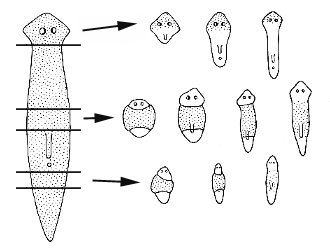
 This half sized embryo now has a complete morphogenetic field even though it is half the size; no machine would do that. The same goes for plants, you can cut a plant up into lots of little bits and each cutting could become a new plant, you can make thousands of cuttings from a willow tree. You can cut up a flatworm into three bits at the head and tail and it generates a new head and tail from the middle part, if you cut it length ways it regenerates a new half. Each of these new frangments has the field of the complete worm associated with it which leads to this regenerative process. Here is the regeneration process of a planarian:


  Humans have far less regenerative powers than say newts or other animals, but far from negligible else we would not heal after injury. If you chop the arm off a newt it will regenerate until it completely grows back, and this can be understood in term of the field associated with the limb even though the limb is no longer materially there. 


This could be an explanation to what has become known as phantom limb phenomenon, what people feel is the fields habit of regeneration where there is no longer any limb. Newts can even regenerate the entire lens of an eye (http://www.ncbi.nlm.nih.gov/pubmed/15558488). In a laboratory the lens was surgically removed, producing a form of damage that would lever usually happen in nature, and what happens is the edge of the iris forms a new lens and regenerates a perfectly functional eye, whereas in the embryonic formation of the eye the lens does not form the edge of the iris but from a flap of skin on the outside. So it has formed a completely new lens in a completely new way using a different tissue than it would normally arise from, showing that there appears to be a blueprint for the complete eye that allows the regenerative process to occur. 


The part of the theory that some find controversial is the 'attractor' nature of the morphogenetic fields, that there is a end state that attracts matter until the organ has fully embryonicly developed or an attractor that uses the physiological ability of the organism to regenerate to try to grow back a limb from the field blueprint.

A main property of a morphogenetic field is that they are hierarchically organized. Such as with atoms in molecules and molecules in crystals, the same goes for cells, cells in tissues, tissues in organs, organs in organisms, organisms in societies; everywhere you look in nature there are levels of organization, the parts of one are wholes at another level. Appreciating the totality and wholeness of nature is what a holistic perspective is, whereas a reductionist perspective tries to reduce everything to the smallest possible thing. 


Attempting to counter reductionism with a holistic perspective Sheldrake assigns a nested hierarchy to the morphogenetic field so the field of an organelle cell is inside the field of the cell, the field of the cell is inside the field of the tissue, the field of the tissue is inside the field of the organ; and these fields work on the lower level fields of the system, giving them morphology and pattern. Sheldrake also states that the morphogenetic field is only one kind of organizing field, the nervous system is highly indeterminate in its behavior and is moderated by another set of fields, behavioral fields. Mental activity is moderated by mental fields. Social groups like flocks of birds or termites are moderated by social fields. All these fields Sheldrake refers to as morphic fields, and morphic fields are the general category of which morphogenetic fields are only one species, the kind of field for the development of form of life as we know it on Earth.

Sheldrake claims that the mathematics of the field is standard field theory, and just like in physics, there are different nested fields of these. Just like electromagnetism dominates at the molecular, it is nested inside gravity, and the small nuclear force is nested inside electromagnetism. He includes in this some intrinsic field probability properties, as everything we associate with life in science is pretty much indeterminate over a long time frame. Just like the weather is a chaotic system so does not obey definite laws life is more probabilistic than deterministic, if you look at all the different leaves on a specific tree they all gave the same mechanical building blocks they all have the same genes and the same morphogenetic fields yet every leaf is different. They all have the same general form, the same probability structure, but they are individually different, and the morphic fields impose patterns on probabilistic processes, they impose patterns of form onto developing organisms and patterns on the activity of the nervous system, so they underpin behavior and social organization as well.

A materialist may ask what gives the morphogenetic fields their form, is it the genes? Sheldrake says no, we know what genes do, they encode for proteins and are involved in protein synthesis, they don't explain the form of an organism they give us the parts to make it, a bit like the components in a TV set.

Sheldrake rejects comparisons between morphic fields and platonism, the philosophy that platonic equations exist outside time and space, because fields evolve. Dinosaurs came into being they are now extinct, animals and birds fields evolved from dinosaurs, they weren't all there at the time of the Big Bang or the origin of life on Earth. He explains this as the fields having a kind of memory of previous forms that arises from morphic resonance; the influence of similar patterns of activity on subsequent similar patterns of activity across space and time. So what matters is similarity, like other fields like the gravitational field or quantum field, it doesn't matter about the distance in space and time. Einstein (I think) called this spooky action at a distance, as every atom in the universe is acted on simultaneously by such fields. Any form that has happened before in the self organized biological system will make it easier to happen again.

This creates what could be referred to as a kind of collective memory in each kind of field, each species of plant has a kind of collective memory, as will each species of animal, a memory of form as the organism develops and an epigenetic memory of behavior, the collective heritable memory for animals and their instincts and patterns of behavior. This implies many laws of nature are more habits than anthropomorphic laws, the longer the habit is re-enforced the harder it is to break. I would not be happy extending Sheldrakes theories into laws of physics as readily as he does, however, he seems to have subject specific bias in this regard. According to him everything has this kind of memory, including crystals for example. If you make a new crystal that has never existed before there will not be a morphogenetic field for it you have to wait for one to come into being, but if you keep doing the same thing and make crystals all over the world it becomes easier to crystallize, things will form more readily.

This is known to happen when it comes to crystals, they are easier to crystallize the more often they are made. This happens in part because chemists share appropriate techniques, but the common conventional explanation for this phenomenon is that fragments of crystals are carried around the world from lab to lab where they serve as 'seeds' for subsequent crystallizations. The folklore of chemistry is littered with anecdotes on this subject. The carriers for these seeds are usually migrant scientists, especially chemists with beards, which can 'harbor nuclei for almost any crystallization process'. An easy way to test the morphic resonance theory for this would be to separate a crystallization laboratory from contamination and ensure the technique and staff stayed the same.

A few experiments that relate to this have been done with mutant fruit-flies where their balancing organs have been transformed into an extra pair of wings.


 The wings are a bit like the wings of an ancestor of flies; dragonflies, which adds credence to Sheldrakes hypothesis; through changes in genes it's as if the fluitfly flicked the channel or operating system back to an old one. And for reasons no body really understands you can produce the same effect by changing the environment of fruit-flies. If you expose three hour old fruitfly eggs to fumes of ether the flies that develop some of them develop with four wings instead of two, this experiment was first done by Waddington some 50 years ago ( http://onlinelibrary.wiley.com/doi/10.1002/jez.1401990103/abstract ). He found if you keep doing this over the generations more and more flies develop abnormally. At the time he put this down to a genetic effect, but it has since been reproduced at the open university by Dr Mae-Wan Ho and colleagues and over a series of generations, with an inbred strain so you can have no genetic effect, the number of mutant flies increased roughly linearly with each generation up to 35% of the population until the ether treatment was stopped and still for generations, at a declining rate, they were forming four winged flies. On repeating the experiment with fresh flies each iteration produced a steeper trend, the flies mutated into the mutated form easier than before, even though the flies had no genetic link to the previous ones.


  The implication of this is that rats should learn a trick faster after a previous rat has worked it out, this idea has received some references in popular culture if I remeber correctly from the forum under the label 'hundredth monkey effect', based on the folklore about how monkeys on disparate islands in Japan all learned exactly the same behavioral technique of washing potatoes man had just recently introduced them to in the sea to make them taste nicer. According to Sheldrake's model, the more a new trait is practiced by the members of a given species, the more likely other individuals will pick it up through resonance, so the same should apply to human beings.

Countless people have learned to type on the QWERTY keyboard. If morphic resonance is real, we should expect people to learn this layout more readily than random layouts. This is indeed the case. Even the alphabetical layout, which should be easier to learn, is often harder to learn, though in a few experiments it was equally easy to learn as the QWERTY layout.  (Norman and Fisher, 1982. Human Factors 24:509-519.) (Hirsch, 1970. Journal of Applied Psychology 54:484-490.)

Arden Mahlberg, a psychologist, carried out a test of the ability to learn Morse Code. He had one group of subjects learn actual Morse Code, while another had to learn a newly-invented code that closely resembled it. He found that subjects were able to learn the actual code far more rapidly than the alternative, and he interpreted this as evidence that the subjects were resonating with the millions of people who had already learned Morse code. Each time he replicated the experiment, he found that the difference in earning time between Morse code and the new one progressively decreased. This might mean that the initial results were false. But the fact that the decrease was progressive suggests that the morphic resonance of the new code was becoming progressively stronger as more and more students learned it. (Mahlberg, 1987. Journal of Analytical Psychology 32:23-34.)

This should mean that football, programming and skateboarding are all getting easier to master with time. This seems to be the case, but it equally could be improved education, improved training videos, new technology, anything; so to test this you need to have standardized experiments where the same test is done over and over again. Sheldrake soon realized that a good test of this would be IQ tests which have been conducted in much the same way for many many years. Morphic resonance predicts that people are get better with time at the tests, not because people are getting more intelligent but because more and more people had already done them. 

James Flyn looked into this and found that just this was happening, which is now named the Flynn effect. 

In every population that has been looked at since the same effect is apparent. The cause of this correlation is still disputed in the literature. Soon Sheldrake discovered that in Holland the exams come in three or four versions, questions 1-8 are on one paper and questions 9-16 on another, etc, to avoid cheating. In effect the entire dutch exam system is set up as a morphic resonance experiment. Dick Beerman from the university of Amsterdam has recently looked into the data from eight psychology exams and found that in seven out of eight the questions done afterwards had higher scores done before, his assistant is now looking into the archive data to avoid sample bias for a more statistically significant correlation. 

Not content with what he had found Sheldrake felt the need to back up his very controversial theory with ways he could test morphic resonance himself, to try to win over the skeptics. The first experiment he conducted was with puzzle pictures broadcast on TV, where it's hard to make out what the picture is of. He tested people under controlled conditions in Germany and other parts of Europe and found out how many of them could recognize the hidden image. Then one was selected at random and 8 million people in the UK saw the image and answer on tomorrows world when someone had to solve it. The question was would people in Germany be able to get the image far faster in Germany than they did before, so the experiments were repeated, and they did. Then it was repeated on ITV in Britain and it worked a second time, these results were published in New Scientist. The Tomorrow’s World experiment was successful in Europe but not in North America. The rhyme experiment was again successful but many complained that the old rhyme was easier to learn than the new one, the same problem occurred with the language experiment. The reason why the old rhyme is nearly always easier to learn is a matter of contention.

I would keep typing had I not just stumbled upon a well written dissertation, that gives a far more comprehensive summary of Sheldrakes science and experiments at skeptico.com where the author examines all of Sheldrakes publications in light of scientific evidence and contrasts this with the skeptical cultures reaction and the scientists reaction for each. Here is the paper, with references to each study:

 Rupert Sheldrake and the wider scientific community


I will quote the conclusion:

The guiding philosophy of modern western science is an idea of being predominantly open minded, impartial and objective. These virtues are said to maintain ‘fairness’ in the scientific community, yet many of Dr. Sheldrake’s critics (most of who are well-respected in their fields) seem go against the norms of science. John Maddox seemed to become emotionally committed to denouncing Dr Sheldrake’s theories by using extreme language to attack his work. Such emotion against fellow scientists itself goes against the core values of science, and at the same time perhaps explains why so many scientists seem to lose objectivity in relation to Dr Sheldrake, and why they are compelled to break the norms of science.

When Peter Atkins admitted he hadn’t read the research on telepathy, he justified his criticism of it by saying “I’ve read [Sheldrake’s] experiments in the past on other off the wall ideas that [he’s] had.” During a debate at the Cambridge Science Festival in 2009, Lewis Wolpert said he wouldn’t trust Dr Sheldrake’s research ‘for a second’. Judging a scientist’s research based on  their past work goes against the norm of universalism which is the view that research should be judged on its own merits.

The way in which Richard Wiseman presented the results of his dog experiment would seem to go against the norm of disinterestedness, as although his results matched those of Dr Sheldrake’s, Wiseman’s paper did not state this and instead the results were given in a way which support his view that the dog was not telepathic.

Institutions such as CSI (formally called CSICOP) claim to be good examples of organised scepticism, however many of their actions would seem to be more like those of the counter-norm organised dogmatism. Scientist David Marks unexpectedly repeated Dr Sheldrake’s results in a staring experiment, and then searched for and found a ‘flaw’ in his experiment which he went on to suggest was the reason for Sheldrake’s positive results as well. Although Marks spent a great deal of time critically scrutinising why he repeated Dr Sheldrake’s research, he did not do the same with his resulting theory on how he achieved positive results. Organised Scepticism is clearly applied to Dr Sheldrake’s work but not to the theories and research which disputed his results.

Perhaps, one day, the theory of morphic resonance will be vindicated and telepathic phenomena accepted. In which case Rupert Sheldrake will surely be remembered alongside Isaac Newton, Charles Darwin and Albert Einstein, and his detractors looked upon with the same indifference as the Cardinals who refused to look through Galileo’s telescope. But even if Dr Sheldrake’s theories are disproved and his experimental results shown to be unsound, it still seems unlikely that those within the scientific community who have condemned Dr Sheldrake and his work will be looked on kindly by future generations of scientists. For surely the harsh rhetoric, the refusal to look at results before criticising them, and the misrepresentation of events and data is far more damaging to science than some incorrect theories and a few flawed experiments.


I'm of the opinion that extraordinary claims require extraordinary proof. This would definitely need extraordinary independent proof, conducted over many many years. It seems a few phenomenon can be best explained by his theory on the face of it, but the small scale nature of the some of the experiments and his methodology deserves the full attention of skeptics and scientists, as Sheldrake says himself the informed skepticism of scientifically minded skeptics is of paramount importance. It does not deserve dismissal by people before they have even read what he has to say and what evidence he gives, which is what happened in a thread I started at JREF before I got the chance to even post any worthwhile material. By far the best replies in the thread I started were made by PixyMisa on page seven it just amazed me that the thread could go on for so long until some informed and well reasoned skepticism emerged. Linking to Sheldrakes later research is always more controversial, I never got to post the other less controversial material there, or give the background about why I was even contemplating for a minute taking this guy seriously.

His later research on phone call telepathy, dog telepathy, and the sense of being started at type phenomenon, all I suspect may various problems with the methodology and conclusions. However they have all tended to support the morphic field theory he was attempting to test, even if they run counter to traditional scientific orthodoxy and common sense. At this point no real conclusions can be drawn about the veracity of his most recent research until it is done again with far larger sample sizes and better controls.


I can't help but think the conversation about Sheldrake on JREF went much along the rather embarrassing interview Richard Dawkins had with him for his series 'The Enemies of Reason' (generally, a fine series, revealing many new age religious crackpots fleecing money off people). For a series that was intending to use Sheldrake as the main example of pseudoscience and bad science, they ended up not including even a mention of him in the documentary when he actually presented scientific evidence.


I will quote what happened in that encounter:


Richard Dawkins comes to call

An atheist and author of The God Delusion, Richard Dawkins is Professor of the Public Understanding of Science at Oxford University. He is a Fellow of CSI (The Committee for Skeptical Inquiry, formerly CSICOP) and a strong supporter of James Randi. His earlier books were on evolutionary biology, the best known being The Selfish Gene. In 2007, he visited Rupert to interview him for his TV series Enemies of Reason:


Richard Dawkins is a man with a mission – the eradication of religion and superstition, and their total replacement with science and reason. Channel 4 TV has repeatedly provided him with a pulpit. His two-part polemic in August 2007, called Enemies of Reason, was a sequel to his 2006 diatribe against religion, The Root of All Evil?

Soon before Enemies of Reason was filmed, the production company, IWC Media, told me that Richard Dawkins wanted to visit me to discuss my research on unexplained abilities of people and animals. I was reluctant to take part, but the company’s representative assured me that “this documentary, at Channel 4’s insistence, will be an entirely more balanced affair than The Root of All Evil was.” She added, “We are very keen for it to be a discussion between two scientists, about scientific modes of enquiry”. So I agreed and we fixed a date. I was still not sure what to expect. Was Richard Dawkins going to be dogmatic, with a mental firewall that blocked out any evidence that went against his beliefs? Or would he be open-minded, and fun to talk to?

The Director asked us to stand facing each other; we were filmed with a hand-held camera. Richard began by saying that he thought we probably agreed about many things, “But what worries me about you is that you are prepared to believe almost anything. Science should be based on the minimum number of beliefs.”

I agreed that we had a lot in common, “But what worries me about you is that you come across as dogmatic, giving people a bad impression of science.”

He then said that in a romantic spirit he himself would like to believe in telepathy, but there just wasn’t any evidence for it. He dismissed all research on the subject out of hand. He compared the lack of acceptance of telepathy by scientists such as himself with the way in which the echo-location system had been discovered in bats, followed by its rapid acceptance within the scientific community in the 1940s. In fact, as I later discovered, Lazzaro Spallanzani had shown in 1793 that bats rely on hearing to find their way around, but sceptical opponents dismissed his experiments as flawed, and helped set back research for well over a century. However, Richard recognized that telepathy posed a more radical challenge than echo-location. He said that if it really occurred, it would “turn the laws of physics upside down,” and added, “Extraordinary claims require extraordinary evidence.”

“This depends on what you regard as extraordinary”, I replied. “Most people say they have experienced telepathy, especially in connection with telephone calls. In that sense, telepathy is ordinary. The claim that most people are deluded about their own experience is extraordinary. Where is the extraordinary evidence for that?”

He produced no evidence at all, apart from generic arguments about the fallibility of human judgment. He assumed that people want to believe in “the paranormal” because of wishful thinking.

We then agreed that controlled experiments were necessary. I said that this was why I had actually been doing such experiments, including tests to find out if people really could tell who was calling them on the telephone when the caller was selected at random. The results were far above the chance level.

The previous week I had sent Richard copies of some of my papers, published in peer-reviewed journals, so that he could look at the data.

Richard seemed uneasy and said, “I don’t want to discuss evidence”. “Why not?” I asked. “There isn’t time. It’s too complicated. And that’s not what this programme is about.” The camera stopped.

The Director, Russell Barnes, confirmed that he too was not interested in evidence. The film he was making was another Dawkins polemic.

I said to Russell, “If you’re treating telepathy as an irrational belief, surely evidence about whether it exists or not is essential for the discussion. If telepathy occurs, it’s not irrational to believe in it. I thought that’s what we were going to talk about. I made it clear from the outset that I wasn’t interested in taking part in another low grade debunking exercise.”

Richard said, “It’s not a low grade debunking exercise; it’s a high grade debunking exercise.”

In that case, I replied, there had been a serious misunderstanding, because I had been led to believe that this was to be a balanced scientific discussion about evidence. Russell Barnes asked to see the emails I had received from his assistant. He read them with obvious dismay, and said the assurances she had given me were wrong. The team packed up and left.

Richard Dawkins has long proclaimed his conviction that “The paranormal is bunk. Those who try to sell it to us are fakes and charlatans”. Enemies of Reason was intended to popularize this belief. But does his crusade really promote “the public understanding of science,” of which he is the professor at Oxford? Should science be a vehicle of prejudice, a kind of fundamentalist belief-system? Or should it be a method of enquiry into the unknown?

Michael Shermer is another fine example of the type of pseudosceptic that (seemingly) populates JREF that we need shot of to form a truly transformative society based on reason:


Dr Sheldrake went on to publish the findings of his experiments in a book appropriately entitled The Sense of Being Stared At: And Other Aspects of the Extended Mind. In a USA Today article, Michael Shermer, publisher of Skepticmagazine, condemned the researchsaying “[Sheldrake] has never met a goofy idea he didn’t like”. Shermer went on to say that the seemingly anomalous phenomena described in the book “are perfectly explicable by normal means”.[38]

However, when Dr Sheldrake asked Shermer to give an example of the ‘normal means’ he described, Shermer could not, stating that he had ‘not gotten to’ reading the book or related papers.[39]


In March 2003, Dr Sheldrake challenged Shermer to a debate, which he accepted, and several times and venues were suggested, but all were rejected by Shermer. As of 2009, the debate has still not taken place.


Sunday, 31 March 2013

JREF forum seems to support political ideology more than they support scientific literacy


Since my recent suspension from the jref forum after amounting a healthy 5000 posts I feel obliged to comment on the banning, which I feel was based on a misunderstanding of what the post actually meant. Also to address a cultural and political bias on JREF that increasingly came to my attention since I was banned. What I would have eventually posted on forum I now have to publish off forum until the length of the suspension and reason for it is made clear to me, hopefully this blog will not have to stay up for long. I can delete it all with a simple click.

JREF forum is a great place, if not for it's moral stance on various issues but for the standard of education of the members; compared to most forums it has a startlingly good signal to noise ratio. The currency of respect at JREF seems to be your adherence to a skeptical philosophy about all claims made by people in similar positions as randi himself but with less integrity, people who make a dubious living by deceiving people with magic tricks (often couched under the guise of religion, alternative therapies or 'newagey' terms) Randi is essentially a conjurer, just he is an honest conjurer and admits this is his profession whilst educating the public on popular ways they are deceived. One way is by advocating internet based eduction of the general public through the forum. 

The fact that randi has no scientific credentials to assess himself what classifies peudo-science from real science becomes redundant since the forum and members provide a interdisciplinary safety net against accusations made against his person or organization; a discussion of the cynical scientific philosophy of JREF deserves a new post in itself, there is too much to continue discussion about it in the context of this blog, and depends on how long the ban is for. I have received no information about the length of the suspension/ban or reason for the ban. I have received no previous suspension, or even warning, relating to similar type posts in the past. I have assumed it was for the last thread I started. My password simply stopped working one day.

I was banned for asking if anyone knew of an ayahuasca clinic in the UK similar to the one I had legally used with the UDV in Brazil. Such clinics are legal in the USA and many other countries. The purpose of them is primarily social and, if you choose to, medicinal as well. I found one, it took me two days, and surprisingly was only 50 km from home. It was a humbling experience.


The stated mission: “JREF has always placed education at the core of its mission to promote critical thinking and provide the public with the tools needed to reliably examine paranormal, supernatural, and pseudoscientific claim". A noble goal. However if you take into consideration the central role science and maths play as the forum driving force this leads to a paradox, as the scienctific evidence is in support of the position I took and firmly against the culture of alcohol, tobacco and caffeine, on well proven health grounds. For a forum that prides itself on skepticism a bit more skepticism of the law as it relates to drug prohibition and the driving forces behind the industry would be a great start to creating a more user friendly environment based on concrete science, especially as it relates to rule one.


When thinking about drugs culturally we tend to focus on episodes of intoxication, but many drugs are used in sub-threshold or maintenance doses; coffee and tobacco are obvious examples in our culture. The result of this is a kind of 'ambience of intoxication'. Like fish in water, people in culture swim in the virtually invisible medium of culturally sanctioned yet artificial states of mind. Culture is more a habit of a social group constrained by the media of choice than a reality, the fossilized version of which would be religion, which for the west is pathological monotheism.


The ways in which humans use plants, foods, and drugs cause the values of individuals and, ultimately, whole societies to shift. The effect of drink culture is all too readily becoming apparent to our health services. Eating some foods makes us happy, eating others sleepy, and still others alert. We are jovial, restless, aroused, or depressed depending on what we have eaten. Society tacitly encourages certain behaviors that correspond to internal feelings, thereby encouraging the use of substances that produce acceptable behaviors with little side effects whilst discouraging destructive compounds. 

As it applies to drugs and the law JREF rule one becomes largely redundant on an international forum; the distinction between what is and what isn't illegal in a country varies considerably. Different countries have different levels of cultural programming dedicated to anti drug 'just say no' eduction and thus legislation, this is not dependent on definite health and science based rules but circumstantial situations under which certain classes of drug were deemed 'good' or 'bad' some 50-60 years ago now by random politicians who long ago left office. Many countries, such as Portugal, have decriminalized drug use all together.


The UniĆ£o do Vegetal in Brazil (UDV) is a fine example, which is the most well known case of exceptions to international drug laws being made for a culture, as even though one of the active drugs found in their psychoactive brew is illegal they were able to show based on empirical science that the positives outweigh the negatives, allowing them to legally use the brew in Brazil. Many members of the UDV were themselves physicians, psychiatrists, or had other kinds of medical expertise, and so were most receptive to the notion of conducting a biomedical study of ayahuasca when it was proposed to them by Luna and McKenna.  


Besides the opportunity to satisfy scientific curiosity about the human pharmacology of hoasca, the UDV had a political motive for carrying out such a study; they wanted to be able to demonstrate to the Brazilian health authorities that the long-term use of hoasca tea was safe, and did not cause addiction or other adverse reactions. They won an unprecedented case recently at the U.S. Supreme Court allowing the legal use of ayahuasca throughout the USA, they tend to win cases against governments all around the world for members of their community based on this precedent. In the UK due to this the UDV centres are left alone by law enforcement based on the precedent in the USA, giving them legal immunity to the usual 'ayahusaca laws' that govern the rest of the population (never a jail sentence for it's use alone in the western world to date though, odd little fact for you). The hypocrisy is sickening, and the fact the media have still not once informed the general US or UK population about this odd bias in the law makes the situation of the 'war on drugs' even more a cultural illusion maintained only by cultural institutions with a vested interest in maintaining fear icons in the general population; it's certainly not a war based on science, skepticism or a shred of evidence. This is what I got suspended for inquiring about (I think?), asking if there were UDV groups in the UK and where I may be able to find one.
  
Yes kids you heard right, the same drug that's proven efficacy and safety enables legal use, is in the same drug schedule/classification as socially destructive drugs such as heroin and cocaine. The system is rigged, strongly against all scientific evidence and basic scientific literacy, and also in terms of it's perceived goal; to reduce harm to the public. (http://www.ncbi.nlm.nih.gov/pubmed/17382831)


Lets take a further look at rule one as it relates to it's stated goal in the context of drugs.


"1. You will not post anything that can be considered to be potentially criminal. The posting of computer viruses, child pornography, or links to computer viruses or child pornography is strictly prohibited. As are posts made under circumstances indicating a considered likelihood of inciting a violent or felonious act, or an intention or knowledge that its content will be used for, or in furtherance of, any criminal purpose. (Such posts will be moved offline and referred to the appropriate authorities.)"


'Potentially criminal' is an extremely broad sweeping term that could be extremely easily abused, I presume the severity of the breach is decided by the moderating team, who generally do a good job
; I do not wish to cast aspersions on the moderating team, as they are good intended and before my ban they always seemed reasonable.


'inciting a violent or felonious act' drug use is inherently not violent, nor is necessarily even linked to crime. Alcoholism on the other hand shows a marked correlation to crime. A felonious act is also a rather ambiguous term to define as it relates to drug use, for the following numerous reasons.

Many prescription drugs are in fact class B or schedule II substances people are legally allowed to possess, if you have ever had opiate based painkillers or ritalin like substances you have the same schedule drug as someone with cannabis or amphetamines. Recent studies into many drugs previously considered 'drugs with no medicinal use' (Schedule I or class A) is rapidly leading to the reappraisal of this label as premature, mainly for the category of hallucinogens known as Indole based hallucinogens. 

 
MDMA has been shown in the last few years to not only be a treatment for soldiers for PTSD, but a one dose miracle cure for it in 40% of subjects. A recent study at John hopkins on psilocybin mushrooms also showed similarly remarkable results, the m
agic mushrooms also appear to produce long lasting positive effects after just one adequate clinical dose. "One month after sessions, a majority of the volunteers (61 percent) considered their psilocybin experience during either or both of the two highest dose sessions to have been the single most spiritually significant of their lives, and most (83 percent) rated it as among their top five." This article links to the research. The same has been shown for DMT many times (why they win every court case), I linked to some studies conducted in mexico, brazil the UK and the USA a day before my account stopped working in the science section in response to someone asking me for evidence in ayahuascas clinical efficacy in treating addictions.

Additionally, the perceived severity of crime punishment in a culture is usually more severe than it actually is, for instance GBL is a class C drug here in the UK (it's a prodrug to GHB, a natural human metabolite and a nutrient found in fish) yet there have yet to be any law authorities to charge a user in the uk with its use since it's often used by garages (legally) to clean alloys, so complicates the classification and economic market. Similarly to ayahuasca, since a group is allowed to use it legally, there is, in effect, a 'silent law' that it's not prosecutable, especially in high profile cases where the more expensive lawyer knows basic legal shortfalls of drug laws. The circumstantial use of a drug and how rich the or clever the person being prosecuted or their lawyer is, plays a central role in law now, much more than it used to. The same is true also with cannabis, a class b drug here. Police will take cannabis off users, issue warnings or a fine, but tend to only charge the dealers with a felony. Christopher Hitchens did some research into this before he sadly left us and could not find a single case of a person in the UK in jail for possession of cannabis alone, commenting further: "Marijuana is a medicine. I have heard and read convincing arguments and had convincing testimony from real people who say that marijuana is a very useful medicine for the treatment of chemotherapy-induced nausea and for glaucoma. To keep that out of the reach of the sick, it seems to me, is sadistic." I am not one for arguing legalization of drug use personally, as it's already largely in place (in the UK, at least), I will let the paranoid stoners get on with arguing that pointless debate with the corporate shills that want to impose order on a population that are determined to alter states of mind and dissolve traditional cultural paradigms.

Which gets to a key point, why people use these illegal drugs at all and if the growing rise in mental health issues in the west correlates to the growing rise in use of short acting recreational drugs in the west. If so, even if not so in fact, they are in dire need of a more clinical reappraisal: recreational drugs are culturally sanctioned medicines for the mind that lack the typical three stage clinical trials that typically define a successful medicine, they pass a cultural test of safety, reliability/repeatability and efficacy instead of a clinical one. If a recreational drug has bad health effects or produces damage to health it will not gain long term cultural acceptance, and thus will likely not be studied clinically to pharmaceutical drug standards. For example, a spout of 2c-t-7 related deaths was reported in the 1990's and was enough to drop it's use ten fold compared to other 2c-x compounds, it virtually took it off the market.

Clearly the self administration of psychoactive substances, legal or illegal, will be increasing worldwide as a part of the future unfolding of global culture; in fact the stats show this pretty much worldwide, to varying degrees. By JREF coming down on the harsh side of the law by banning users who make drug related posts without even a suspension to warn them what they did wrong first, they not only are turning their back to a rich counter culture that has spent decades building up a database of harm reduction science for recreational drugs which would be an invaluably more friendly environment for posting members and readers, but it increases the risk of adding to the damage done by anti-science based drug education (confusion might be a better word). It would enable a productive dialogue to ensue about recreational drugs, their health effects, their side effects, etc, rather than what often happens, some of the more intelligent posters just wondering what they are allowed to post and not even risking posting valid information. I can not remember ever having a specific warning about posts that could be interpreted as drug related, I in fact asked for a couple of my own posts to be moved to deep storage retrospectively myself as I was not happy with making some of my pharmacology knowledge so public, most of my cautions were for posting images and hijacks, if I recall correctly. 

This a change to the rules that I'm sure would not even raise an eyebrow online as it's already largely in place, drugs-forum.com ( a purely medicine/drug forum that had always erred on the side of caution with site rules being in accordance with 'international law' ) is now adopting a change to the site rules that allows admitting use of and planned use of drugs, much to the amusement of the spectrum of drugs forums that have been using first person prose since the beginning. It turns out that after speaking to people running drug related forums for nearly a decade not one of them has any evidence that posts made on a forum even attract the attention of drug law enforcement agencies, let alone compromise the security of them (the days of operation web tryp and the hive are long gone). The main forum rule to enforce seems to be not letting users reveal any more precise geographical information than city level in drug related posts and banning discussion of the price of drugs (it can can look like advertising).

Now I'm sure some are thinking 'you can't let kids learn about drugs online', which is only correct to the extent that some psychedelics might react badly with their wellbutrin their adderal their energy drinks their venlafaxine etc. The kids are on drugs already, the problem is they are on the wrong drugs and lack the unbiased scientific eduction to make informed adult decisions. 

There is also an element of cultural responsibility here to honest education, it's now proven beyond doubt that drug laws do not correlate to the harm of the substance and that many many illegal drugs in fact have legitimate scientific application and medicinal use (recent studies into MDMA and PTSD, psilocybin and wellbeing, development of a rational scale to assessthe harms of drugs of potential misuse [the lancet, 2011] etc) so an educational forum that prides itself on evidence should not act as sycophants to a purely political ideology lacking any scientific evidence in its favor. The natural ahahuasca brew that I inquired about in the thread that resulted in the banning is also a drug with no deaths worldwide, proven clinical benefits (I posted these in the science section in reply to roborama) and cliclinically significant effects on habits and addictions. It would immediately put a poster who had a degree in psycho-pharmacology in an extremely surreal situation: either help educate people about his chosen discipline by sharing his knowledge (which no doubt sometimes is going to look like advocating drug use) or get banned. The fact that I wrote in the thread I got banned for in large capital letters 'I am not advocating it's use' seems to have been missed.

For example I would have followed up my post about ayahusaca with the following information and queries if had I known there was going to be an issue.

Asking where you can find the correct local environment for highly psychoactive catnip for your cat that loves it would surely be allowed here? Or even where I may find a grass field with phalaris grass in, an abundant worldwide genus of grass which contains DMT. The work of Festi and Samorini in 1994 documents every newly found alkaloid the grass has, the possibility that there are still a myriad of similar and legal tryptamine compounds to be found therein remains an exciting possibility.

Now I make this point only to demonstrate that the idea “He was asking where he could get psychoactive drugs in his area” is spurious at best, as most people can get this particular one instantly from their natural environment (17+ dominant strains of canary reed grass) I would never be asking to source a chemical fully available to me for free from my garden or local field within a few hours of cursory chemical competence on an online forum, the post was literally about the UDV context of the trip to get the set and setting correct. I have spoken about this relentlessly in the science section (without ever informing people how to do it, of course). Similarly if I was asking on JREF for the location of a rave the chance of substances will be consumed is very high, I will likely either drink ethanol or GHB or do 5-meo-MIPT or 5-MAPB (the legality does not even effect the choice for most people, the science speaks for itself), however asking for where the rave is located, or stating that you enjoyed yourself last time you went, as far as I can tell, is not against the rules. Thus asking for the location of a UDV center in the UK and stating that I enjoyed the last one I went to is in exactly the same territory, the ayahuasca or ethanol use is a secondary or tertiary event to locating the group organizing the event.

Anyone can get DMT, and they need not even get out of bed to get it; as it's been unavoidably located inside all mammalian blood in trace amounts, so our bodies are seemingly seekers, users and even producers of this psychoactive drug, even before the mind has sought it out. Every time we mow our lawn, or even dream when sleeping, our bodies effectively harvest this drug. Just one method produces a heck of a lot of green waste as a by product with no gain in blood concentration. (http://www.ncbi.nlm.nih.gov/pubmed/22371425)
If I was asking for a group that is notorious for using crystal meth I could maybe understand the banning. As it stands I got banned with no warning or dialogue ensuing for asking if there is a group in the UK that uses something that to date there has never been a prosecution for due to their rich cultural history. The sad irony of the sudden banning is that the person who decided to do it was probably metabolizing more DMT than I was at that time, so was even more on the foul side of the law than me (assuming they were in the USA, have normal melatonin levels and our cardiac rhythms were on normal daytime cycles)
 
It’s role is to bind to The sigma-1 receptor, which has an alkylamine core like N,N-dimethyltryptamine, and research has shown DMT to be an endogenous agonist for the sigma-1 receptor. (http://www.sciencemag.org/content/323/5916/934.abstract)


So what I am saying is that DMT is the most interesting of the psychedelics because more scientific issues are raised by it than any other. Lets run over a few of them; DMT is the strongest hallucinogen there is, if its possible to get more loaded than that, I don't want to know about it, keep it away from me. It's also the shortest acting, DMT when smoked most people are back to normal within 10-20 minutes. People that think there is nothing to this should invest these ten minutes to find out what its all about, which is probably worth more than 20 years of academic pharmacology, art history, psychology or neurophysiology. Another very interesting thing about it is that it occurs naturally in the human brain, and all mammalian blood. So I'm saying that the strongest drug, the fastest drug and the most profound is the most natural drug. It means you don't have to sail off into 4-hydroxy-4-pyroldeindole-N-methyl-rhubarb-berrubistik to get into the exotic realms, no, a simple human metabolite which takes only ten minutes to undergo it's entire exfoliation and quenching is the strongest of all. 

Our bodies containing this active psychoactive, is highly illegal according to the state definition. Lock yourself up, you would almost certainly fail a blood test for DMT. Anyone with phalaris in their garden is technically producing this scheduled drug. Science is a lot more accommodating, and it's been deemed a fruitful area of scientific inquiry, even though work has only begun properly a year or so ago into it’s possible role and effects. Cultures like the UDV that have used it for centuries know exactly what it’s about,even legality in the USA. I merely queried if anyone knew of UDV groups in the UK that use the brew that elevate the levels of this natural neurochemical.


'(Such posts will be moved offline and referred to the appropriate authorities.)' if this applies to drug related posts then said authorities will use the same policy they do with all drug related internet posts, ignore them as if they were invisible
 and not admissible in a court of law (which they generally aren't, not one forum out of 10 drug based forums has one account out of 1,000,000 users of their forum posts being used by law enforcement).

Languages appear invisible to people who speak them, yet they create the fabric of reality for their users. The problem of mistaking language for reality in the everyday world is only too well known, people who read a lot will tend to read nature even when they lift their eyes from their books; they do not see nature. As Feynmann said "I learned very early the difference between knowing the name of something and knowing something." Plant use is an example of a complex language of chemical and social interactions. Yet most of us are unaware of the effects of plants on ourselves and our reality, partly because it's been largely forgotten by modern culture that plants have always mediated the human cultural relationship to the world at large, severing any potential symbiotic relationship we may have had. It's been nearly 20 years since Lovelock came up with his gaia hypothesis, a wonderful cultural addition to the scientific world view, which is easiest described as the general term for seeing Earth as a living organism comprised of complex feedback loops and relationships rather than an external mechanical thing. In Gaia theory, tipping points, chaos theory and fractal topologies dominate over linear maths, scientism and the illusory disciplinary boundaries between academic subjects created by institutionalized science.


In a nutshell: We have had a mind-programming exercise, called "the war on drugs" for the last 40 years, which has been designed to create an internal enemy in our societies and convince people that there are these evil, wicked groups who are doing these terrible, sinful things, smoking these drugs and doing this and that. A very dark image has been created around this and people get very upset irrationally about this whole issue. As Huxley said "LSD is a drug that can cause psychosis in people who have never taken it".


By all means some drugs are bad and toxic, to society and the individual, and their recreational use should not be entertained, it's lack of accurate education of the science in this field in the face of cultural pressures that cause the addiction issue we see rampant around the world. Societies with massive underground drug addictions that simply don't know any better, as they never differentiated between a dose of mushrooms and a dose of crystal meth.


And actually what's been forgotten in all of this, is that when the state sends us to prison for essentially exploring our own consciousness this is an grotesque abuse of human rights. It's a fundamental wrong. If I as an adult am not sovereign over my own consciousness then I'm absolutely not sovereign over anything. I can't claim any kind of freedom at all, and what has happened over the last 40 or 50 years under the disguise of the war on drugs, is that we have been persuaded to hand over the keys of our consciousness to the state. The most precious, the most intimate, the most sapient part of ourselves, the state now has the key ... and furthermore they have persuaded us that that's in our interests! This is a dangerous situation, we are giving power over to the least among us. 


Hopefully JREF will change its use of rule one, an instant banning without even asking the poster of the intent behind the post is simply leaving far too much room for subjective errors. If no change occurs the global internet culture promptly being erected before our very eyes will pass JREF off as just another insular online community.


As much as I like the community for teaching me everything it has I just don't like the anti science political overtones that (apparently) come bundled into the rules. Saying that, I remember speaking numerous times quite openly about it in the science section, and have started a fair few threads on the subject. One post in the science section about the UDV was nearly identical in content to the one I started in the community subforum that resulted in the banning, it seems that the rules apply differently to different subforums, depending on who reads the post first, how they interpret it, and depending on how many scientific references you supply. Since I had no idea some of my cautions were breaches of rule one anyway (I thought they were nearly entirely for posting images and hijacking) I would have been nice to be informed of this at some point in a private message from a moderator, or even by a suspension. And considering the use of the brew in the context I queried about is totally legal, I hope the moderators have enough integrity to lessen the length of the suspension.

It's amazing how much you learn playing devils advocate on a forum, retrospectively JREF forum is probably the worst to do it on. Getting coherent non reactionary ripostes was like trying to squeeze water out of a stone sometimes. Dinwar was uber amazing at giving great long and informative replies. Some users were absolutely useless at explaining their argument or shooting down my various perspectives in a productive fasion, which gave me free reign to post all sorts of hyperbole to try to induce eductional posts. No, I don't think Sheldrakes dogs are psychic. No, I don't think plasma cosmology (in it's current form) is a viable alternative to the Big Bang Theory. No, I don't think 9/11 was an inside job. And no, I'm not Eric Lerner.